At a glance
- Package
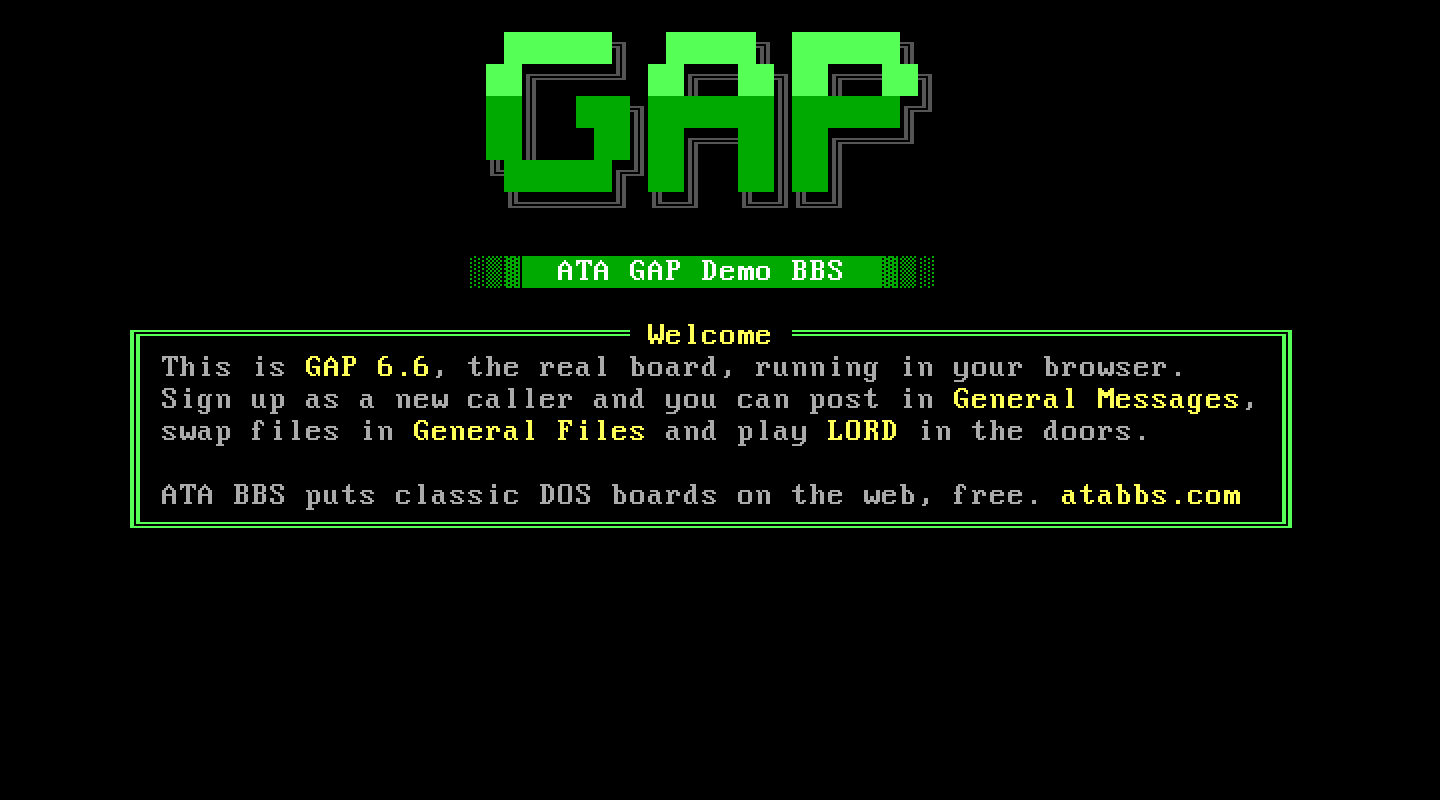
- GAP 6.6, GAP Development Company (GAP Communications), its last DOS release
- Lines
- Three: GAP's bundled build numbers its nodes up to three. Proven: three.
- Starting account
- SYSTEM OPERATOR (first name SYSTEM, last name OPERATOR)
- Callers page you with
- P at the main menu
- Console keys
- Answer: Ctrl and F10. Break in: F10. Leave: Esc.
The board
What ATA set up. Every C: path turned to D:, a node directory for each line (GAP\NODE1 to GAP\NODE3, each with its own GAPBBS.CNF), GAPMENU's "Modemless Connection" so a caller is logged on when the line rises, the NOPAGE screen removed (it answered every page with office hours instead of ringing you), the sample upload check removed (its shell hung every upload), a missing upload work directory made, and EDFSLOW, ATA's small helper that keeps GAP's memory swapper from overwriting the machine's network drive when GAP runs a door or a protocol.
The DOS page. "GAPMENU" is the call-waiting screen and the way into everything: its Commands menu has Sysop In (a local logon), the Configuration editor (GAPSETUP) and the User Editor.
Making it your own. Commands, Configuration (PgDn through its pages: the local password, the sysop name, the board name, the port page). Commands, User Editor sets levels and passwords. Change the local and operator passwords before letting callers on. Never edit GAPBBS.CNF by hand: ATA wrote the drive letters, port 1 and Modemless Connection the way the editor does.
Callers. GAP asks a first name and a last name. New callers choose a display mode, read the new-user screen and the bulletin menu, then answer the questionnaire: street address, city, state, zip, country, two phone numbers and a birth date in masked fields (each field prints its own punctuation: type digits only, and press Enter if the field does not move on by itself), then a password twice. New members get GAP's own New User Level from its configuration. GAP's pause prompts end in a letter or a period, not a colon.
Paging. GAP rings for thirty seconds and says so on the caller's screen. Its page bell is a toggle (F6) that starts off in every run of the program; ATA presses it once a call so a page can ring at all.
Things to know. GAPMENU saves its own setup file at every exit; on a caller's machine that write is refused calmly, as it should be. If GAPMENU's user editor ever says "Unable To Save - User Already Exists" for a record, run GAPREBLD once from the DOS prompt to rebuild the user index.
Legend of the Red Dragon on GAP 6.6
The steps every board shares (getting LORD, LORDCFG, the wrapper batch) are in the door guide. This is what is particular to this board.
Drop file: DOOR.SYS, in each line's own folder, D:\GAP\NODE1 to D:\GAP\NODE3. LORDCFG: (9) DOORSYS, path d:\gap\node1\ for node 1, d:\gap\node2\ for node 2, d:\gap\node3\ for node 3.
Batch: GAP runs a door with an environment of its own, without ATA's NODE variable, but it runs the door from the line's own folder. ATA puts an empty marker file ATANODE.<n> in each line's folder, so the batch can tell which line it is on. D:\GAP\LORD.BAT:
@ECHO OFF
IF EXIST ATANODE.1 GOTO N1
IF EXIST ATANODE.2 GOTO N2
IF EXIST ATANODE.3 GOTO N3
GOTO END
:N1
D:
CD \DOORS\LORD
CALL START.BAT 1
D:
CD \GAP\NODE1
GOTO END
:N2
D:
CD \DOORS\LORD
CALL START.BAT 2
D:
CD \GAP\NODE2
GOTO END
:N3
D:
CD \DOORS\LORD
CALL START.BAT 3
D:
CD \GAP\NODE3
GOTO END
:END
Do not add SET lines to it: GAP hands a door a minimal environment, and the batch keeps clear of it.
The door list. GAP's door list is the text file GAP\GEN\DOORS.DAT, one door a line: name, level, program. Add:
LORD 10 D:\GAP\LORD.BATThe level is the security level a caller needs (10 suits GAP's ordinary members; set your own). The door menu screens callers read are GAP\GEN\DOORM and DOORMG (plain and colour); add a line naming the door with its number, for example 3 - Legend of the Red Dragon when it is the third line in DOORS.DAT.
Already done for you: EDFSLOW, ATA's small helper, runs before GAPMENU on every line. GAP runs doors through a memory swapper that frees every block of memory above its own, and on ATA's machine that included the network drive's data; EDFSLOW moves it out of the way. Without it every door crashed on its first access to D:.
How callers get there. OPEN at the main prompt, then the door's number.